
Corrosion Information
Hammond offers many different material types in its broad product offering. Deciding on the appropriate material depends on various factors with a major consideration being resistance properties of the material to various chemical laden environments. Below is a general summary of the suitability of the materials offered in Hammond’s product lines. Please consult Hammond for specific questions you may have for a particular environment.
While stainless steel provides excellent performance in most applications, there are certain environments where rust or "tea staining" may develop even on stainless steel surfaces. Some on-going surface maintenance may be required in those environments to maintain a more pristine looking surface.
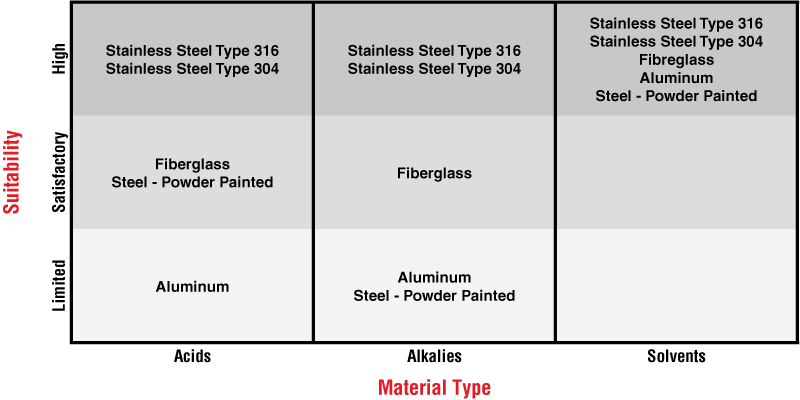
Suggested Applications for Corrosion Resistant Materials
Corrosion Resistance Table for Non-Metallic Enclosures
* Currently undergoing testing - this is a calculated reference.
The table provided is a guide to assist in identifying the suitability of using non-metallic enclosures in various environments. For specific suitability, prototype samples must be evaluated under actual conditions.
Hammond cannot offer guarantees of warranty as actual conditions may differ from test conditions.
Suggested Applications for Corrosion Resistant Materials
| Material Type | Hammond NEMA Rating | Suggested Application |
|---|---|---|
| Stainless Steel Type 304 | 4X | Indoor/outdoor applications. Ideal for hose-down and wet areas (e.g. food processing, water treatment, dairies, breweries, etc.) |
| Stainless Steel Type 316 | 4X | Indoor/outdoor applications. Ideal for most all environments especially marine uses. |
| Aluminum | 4 | Indoor/outdoor applications. Ideal for marine uses as well as environments containing solvents, petrochemicals, some acids and most sulfates and nitrates. |
| Fibreglass Reinforced Polyester | 4X | Indoor/outdoor applications. Ideal for continually wet, cold or salty environments. Also useful in solvent or chemical laden areas. Strong resistance to heat, dilute acids and bases, impact, fire and outdoor exposure. |
Corrosion Resistance Table for Non-Metallic Enclosures
| Chemical and Concentration | Polyester SMC +25% FV Resistance | Chemical and Concentration (2) | Polycarbonate (Trans. Door) Resistance |
|---|---|---|---|
| Acetone 100% Ammonia 5% Aniline purera Benzene pure Carbontetrachloride pure Chromic acid 10% Citric Acid 100% Fresh water Gasoline 10% Hexane pure Hydrochloric acid 30% Lactic acid 100% Linseed oil pure Methyl alcohol 50% Naptha 100% Nitric acid 20% Phenol 5% Phosphoric acid 100% Saturated chlorine water Saturated ether Sea water Sulfuric acid 70% Toluene pure Trichloroethylene pure Hexane Aromatic Hydrocarbons Ethers Fuel Oil Liquid Bromine Liquid Chlorine Mineral Bases Mineral oils and greases Mineral Salts Naphtaline Nitrobenzene Pure Aniline Sulphuric Acid Urea | None High Average* None Average High High* High High None High High* High Average* High* High (20%), None (100%) Average High* High* Average* High High High None* Average None None High None None High High High Average None None High High | Acetone 100% Ammonia 5% Aniline purera Benzene pure Carbontetrachloride pure Chromic acid 10% Citric Acid 100% Fresh water Gasoline 10% Hexane pure Hydrochloric acid 30% Lactic acid 100% Linseed oil pure Methyl alcohol 50% Naptha 100% Nitric acid 20% Phenol 5% Phosphoric acid 100% Saturated chlorine water Saturated ether Sea water Sulfuric acid 70% Toluene pure Trichloroethylene pure | None High* None None None Average* High (10%) High High (100%) High High High (10%) High High (96%) Average* High (10%), None (100%) None High None Average* High High (50%), Average (70%), None (100%) None None |